
Type 2 diabetes: technology and tools for young adults

Young adults with type 2 diabetes face aggressive disease progression and unique psychosocial challenges. Emerging technologies offer opportunities for earlier intervention, improved engagement and self-management. Technology-supported models of care have the potential to address the suboptimal outcomes in this growing population.
- Young-adult type 2 diabetes (YT2D) is a high-risk condition associated with rapid glycaemic deterioration and early complications, requiring proactive and flexible approaches to care.
- Continuous glucose monitoring offers value not only as a
self-management and surveillance tool, but also in supporting earlier treatment optimisation and sustained engagement in care for a population at high risk of disengagement. - Digital self-management tools, including artificial intelligence-assisted application-based lifestyle, weight management and physical activity programs, and messaging systems, can support individuals with YT2D as they align with the life context of younger adults, providing flexible, asynchronous education and support outside traditional clinic settings.
- Artificial intelligence chatbots and large language model-based tools are increasingly visible in diabetes care, but their role in Australia is currently limited to information support rather than clinical decision‑making.
- Emerging evidence supports models that combine team-based care, technology-enabled surveillance and flexible modes of contact, including telehealth, and these may be key to
co-ordination and continuity of care for YT2D. - Technology and tools for YT2D need to be appropriately evaluated and integrated into co-ordinated models of care; there is a risk of widening inequity if not adequately funded and resourced.
The incidence and prevalence of young-adult type 2 diabetes (YT2D) are rapidly increasing, and the condition represents a distinct, more aggressive phenotype than later-onset disease. YT2D, usually defined by diagnosis between the ages of 18 and 40 years, is associated with more rapid beta-cell decline, earlier treatment failure and a disproportionate burden of microvascular and cardiovascular complications, often emerging within the first decade after diagnosis. Premature morbidity and mortality are well documented despite the shorter disease duration.1,2
Psychosocial and life-stage challenges
The challenges in YT2D extend well beyond glycaemia, with the frequent co-presence of elevated levels of diabetes-related distress, depression and anxiety, which directly affect engagement with care. These issues occur at a life stage in which individuals are often completing education, experiencing employment insecurity, planning pregnancy, juggling childcare and experiencing financial stress, all of which present barriers to optimal outcomes.
Traditional, episodic models of diabetes care are poorly aligned with these realities and contribute to clinical inertia and suboptimal outcomes. Those with YT2D often fall into a care gap, and this is commonly observed in general practice.3 Evidence-based guidance is limited, with few randomised controlled trials conducted specifically in young adults, leaving clinicians to extrapolate from older populations with different disease biology and life contexts.
Opportunities with digital health and technology
Digital health technologies have transformed chronic disease management, including diabetes, by supporting self-management, improving adherence and enabling more personalised, continuous care outside the traditional clinic setting. These advances present important opportunities to improve outcomes in YT2D.
For GPs, tools such as continuous glucose monitoring (CGM), app-based lifestyle and weight-management programs, automated prompts for treatment intensification and telehealth-enabled multidisciplinary support can help overcome time constraints and reduce clinical inertia. Emerging artificial intelligence (AI)-driven tools, including chatbots and machine learning-based decision support, offer additional potential through real-time feedback, predictive analytics and tailored recommendations to support healthier lifestyle choices and earlier intervention.4
Importantly, evidence from our own work and similar real-world studies has demonstrated high acceptance and sustained engagement with technology-enabled care among individuals with YT2D.5 Technology-supported models of care may play a crucial role in strategies designed to close the gap between disease risk and real-world outcomes in this growing population. These are discussed in further detail below for the Australian context.
Glucose monitoring technologies
Role of continuous glucose monitoring
Although CGM has traditionally been used in type 1 diabetes and insulin-treated type 2 diabetes (it is not currently funded under the National Diabetes Services Scheme for the latter), its role in YT2D is increasingly recognised. Recently, a small number of randomised controlled trials involving youth with type 2 diabetes have demonstrated improvements in glycaemia and quality of life with CGM, without increasing disease burden.6,7 YT2D is characterised by rapid beta-cell decline and early treatment failure, supporting the need for earlier, more intensive and responsive management strategies than those typically used in older adults. In this context, CGM offers value not only as a surveillance tool for glucose monitoring, but also in supporting earlier treatment optimisation and sustained engagement in care for a population at high risk of disengagement.8 Intermittent use of CGM can help shift the focus towards immediate, actionable insights, support self-reflection in those who are digitally literate and facilitate shared decision-making to avoid therapeutic inertia.
A growing body of evidence suggests that earlier combination therapy is especially beneficial in YT2D and that CGM insights avoid the need to wait for the next formal glycated haemoglobin (HbA1c) measurement before adjusting therapy.8,9 Equity considerations, including cost, digital access and health literacy, remain important, and these factors may limit uptake for some individuals. This reinforces the need to use CGM selectively, as an empowering tool rather than an additional financial or psychological burden.
Insulin pumps and automated insulin delivery systems
The role of insulin pumps and automated insulin delivery systems in YT2D remains uncertain, with most data extrapolated from studies involving people with type 1 diabetes or older adults with insulin- treated type 2 diabetes. Although insulin pump therapy and automated insulin delivery systems can improve glycaemic outcomes and reduce hypoglycaemia in selected adults with type 2 diabetes requiring intensive insulin therapy, there is little high-quality evidence to support their routine use in YT2D. The Insulin Pump Treatment Compared With Multiple Daily Injections for Treatment of Type 2 Diabetes (OpT2mise) randomised controlled trial, which included YT2D, demonstrated improvements in HbA1c with insulin pump therapy compared with multiple daily injections; however, more contemporary data are lacking.10 As a result, current expert opinion supports a highly individualised approach, reserving pump or automated insulin delivery therapy for carefully selected young people with significant insulin deficiency, high insulin requirements or recurrent hyperglycaemia despite optimised therapy, ideally within specialist or multidisciplinary care models. Further research is needed to clarify which subgroups of individuals with YT2D will derive meaningful benefit from advanced insulin delivery technologies.
Digital self-management and lifestyle tools
Despite strong evidence supporting diabetes self-management education and support in older populations, traditional models frequently fail to resonate with individuals with YT2D. Support is often poorly aligned with the realities of young adulthood, including employment insecurity, study, caregiving, pregnancy planning and financial stress. Anecdotally, attendance and completion rates of education sessions are low, particularly among those at the highest risk of disengagement.
Traditional diabetes self-management education and support models commonly emphasise information delivery rather than ongoing support, with an assumption that knowledge alone leads to sustained behaviour change. For young adults experiencing diabetes-related stigma, distress, depression or anxiety, education focused narrowly on targets and complications may feel overwhelming or judgemental, reinforcing disengagement. Education delivered episodically and disconnected from real-time glucose data or daily behaviours can feel abstract and thus difficult to translate into positive change. In this context, there is an opportunity for app-based lifestyle, weight management and physical activity programs to provide self-management education and support.
Digital self-management tools align well with the preferences and life context of younger adults, offering flexible, asynchronous support that can be accessed outside traditional clinic settings (Table). In Australia, platforms such as Health2Sync and mySugr allow individuals to track glucose data, food intake, activity and medications, and to share selected data with clinicians or care teams. When used alongside routine clinical care, these tools can support weight or glucose management, reinforce lifestyle change and promote a greater understanding of the association between behaviours and glycaemic patterns, particularly for young adults who may struggle to engage with conventional education programs. Messaging-based interventions, reminders and app-linked feedback can reinforce goals, prompt medication adherence and support lifestyle changes in real time, without increasing the need for face-to-face visits.
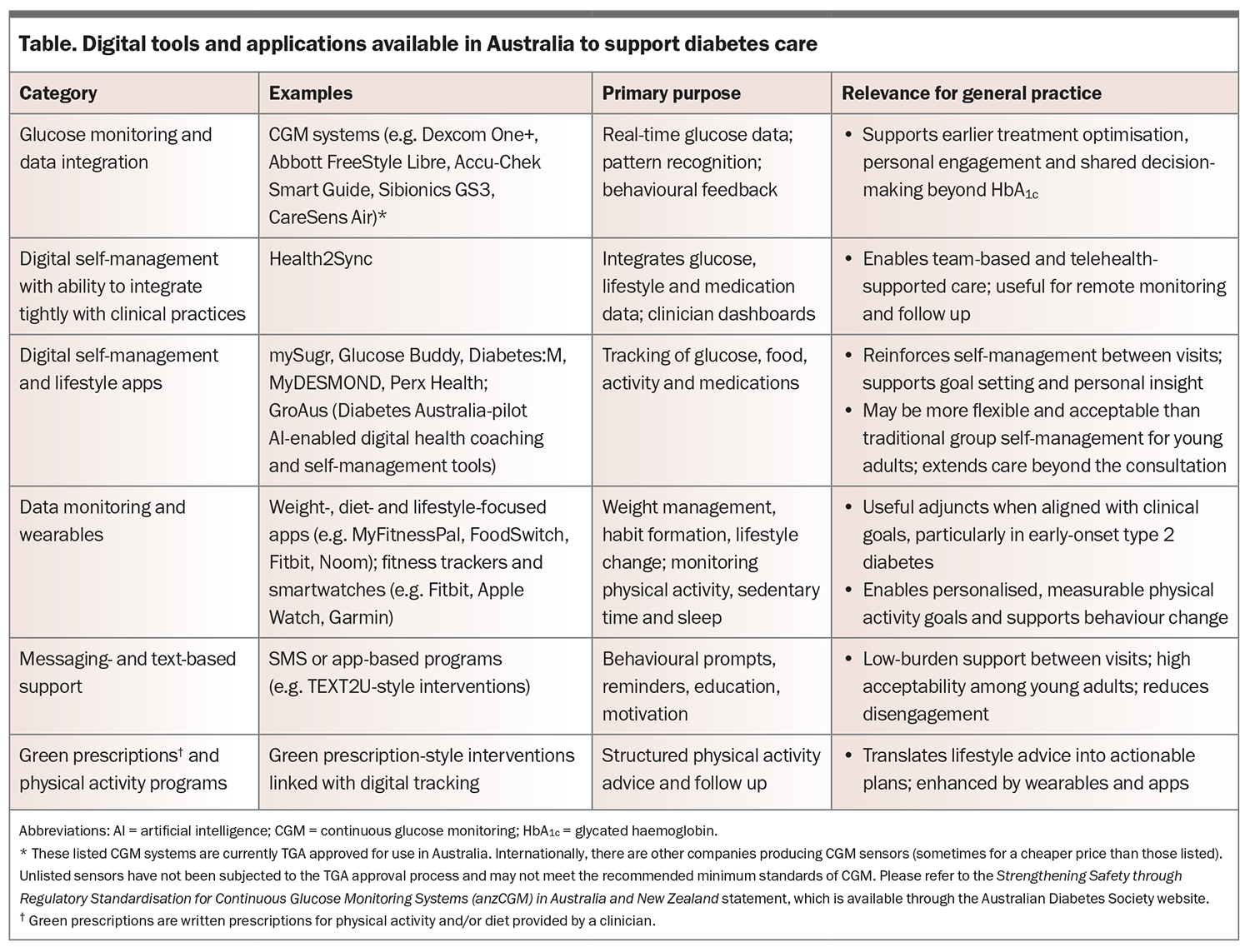
Evidence from the study An Enhanced SMS Text Message–Based Support and Reminder Program for Young Adults With Type 2 Diabetes (TEXT2U) and similar real-world initiatives demonstrate high acceptance and sustained engagement with text- and app-based support among people with YT2D, challenging assumptions that this group is hard to reach.11 These approaches are particularly valuable during periods of life transition, when clinic attendance may be inconsistent but the need for support remains high.
Wearable activity monitors, including fitness trackers and smartwatches, can further support adherence by providing immediate feedback on physical activity, sleep and sedentary behaviour. When combined with structured counselling or follow up, these devices can operationalise ‘green prescription’ approaches, translating general advice about physical activity into measurable, personalised goals that can be reviewed and adjusted over time.
Nonetheless, for digital self-management tools to be effective, they must be intentionally aligned with clinical goals, rather than used as stand-alone interventions. It is also important to consider data security and storage when deciding to use a digital self-management app or service, as approaches vary between providers.
Artificial intelligence in diabetes care
AI chatbots and large language model-based tools are increasingly visible in diabetes care, but their role in Australia is currently limited to information support rather than clinical decision‑making. Chatbots can assist individuals with YT2D by providing education, lifestyle coaching, medication reminders and motivational support, and several AI‑enabled platforms piloted in Australia (e.g. Diabetes Australia-supported digital coaching programs such as GroAus) use conversational interfaces to improve engagement and self‑management. However, general‑purpose chatbots are not approved medical devices in Australia, lack integration with current clinical systems and should not be used to make diagnostic or prescribing decisions. Expert commentary highlights that although large language models can generate guideline‑concordant suggestions, they may be inconsistent, lack context and require careful human oversight, particularly in complex conditions such as YT2D.4
In Australia, AI-driven predictive analytics to identify people with diabetes at risk of deterioration are not yet widely available in routine care. Although emerging models suggest that patterns across CGM data, activity, weight, medication use and healthcare utilisation could help identify rising HbA1c levels, disengagement from care or early decompensation, most of these tools remain in development and face regulatory and implementation barriers.
Some diabetes applications, such as Health2Sync, incorporate AI-assisted features, including food photography to support meal logging and link dietary information with CGM data, helping users and clinicians visualise glucose responses over time. These functions are primarily designed to support self-management and pattern recognition rather than precise carbohydrate quantification or independent clinical decision-making.
At present, predictive analytics in diabetes are largely limited to automated insulin delivery systems, where algorithms predict shortterm glucose trends rather than broader clinical risk. These systems are used in a minority of individuals in YT2D. Although these approaches may become more widely available in the future, they should be used alongside clinical judgement, particularly in YT2D where disease progression can be rapid and follow up inconsistent.
Despite growing interest, the application of AI in diabetes care has important limitations. Evidence for improved hard clinical outcomes remains scarce, particularly in YT2D, and these tools should be viewed as supportive technologies that augment, rather than replace face-to-face medical care.
Technology-supported models of care
The clinical and psychosocial complexity of YT2D highlights the limitations of traditional, clinic-centred models of care. Given the amplified complications risk associated with YT2D, failure to engage and intensively manage disease in early adulthood carries substantial long-term clinical and economic consequences. Simply adding new technologies to existing systems is unlikely to improve outcomes unless they are accompanied by intentional redesign of care delivery.
Emerging evidence supports models that combine team-based care, technology-enabled surveillance and flexible modes of contact, with medical providers remaining central to co-ordination and continuity. From a health system perspective, models that enable earlier intervention, reduce clinical inertia and encourage more efficient use of the healthcare workforce can improve outcomes while containing downstream costs.14,15
Telehealth-enabled care has emerged as a key facilitator of care for YT2D, offering flexibility that aligns with work, study and caregiving responsibilities, but this is most effective when used as part of a hybrid model rather than a complete substitute. Telehealth-enabled models have been shown to improve attendance and engagement among younger adults, particularly when combined with structured follow up and team-based care. For many people with YT2D, brief telehealth reviews supported by shared access to glucose, lifestyle and activity data are more acceptable, more cost-effective (including reduced time off work and childcare costs) and more sustainable than infrequent face-to-face visits alone.
There is emerging evidence that nurse-led telemedicine surveillance and team-based care models offer promise in YT2D, particularly when supported by digital data streams such as CGM, self-management applications and remote monitoring platforms. The nurse-led surveillance model described by Noonan and colleagues demonstrates that structured, protocol-driven follow up led by diabetes-trained nurses can support earlier identification of glycaemic deterioration, timely treatment escalation and improved continuity of care, without increasing specialist workload.12 In these models, nurses monitor incoming data, provide behavioural and educational support and escalate concerns to the GP or specialist if required, enabling care to be proactive rather than reactive. For YT2D, nurse-led models are especially well suited to addressing diabetes-related distress, stigma and adherence challenges.12 Regular, lower-intensity contact helps sustain engagement during periods when attendance at traditional appointments is difficult. From an economic perspective, this approach allows for more intensive surveillance to be delivered at a lower cost than repeated GP or specialist reviews, reserving higher-cost clinician time for complex decision-making and treatment escalation. Importantly, these models extend rather than replace GP care, preserving continuity while making better use of the broader primary care workforce, although they are not yet widely implemented.
Low-intensity text-based and digital support between visits, such as those trialled in the TEXT2U study, provide an additional layer of care and improve attendance and empowerment.11 A randomised controlled trial from China evaluating an integrated internet-based management system in YT2D demonstrated greater reductions in HbA1c compared with standard of care.13 These strategies fit well within nurse-led and telehealth-enabled models of care. Programs should be structured to deliver automated and personalised messaging to reinforce self-management behaviours, clinical goals and follow up between formal clinical encounters. Evidence from our work demonstrates high acceptability and sustained engagement with text-based support among people with type 2 diabetes.11 Programs offered via subscription platforms are available in Australia.
Selecting appropriate tools for individuals
Not all people with YT2D require, or will benefit from, the same technologies. Digital tools are most effective when targeted to young adults at higher risk of disengagement, rapid deterioration or early treatment failure, including those with rising HbA1c levels, significant weight gain, psychosocial distress or competing life demands. Selection should be guided by clinical need, personal preference and capacity to engage, rather than a one-size-fits-all approach.
Tools should be chosen with a clear purpose in mind. For example, CGM may be used to support dietary or activity change, text-based messaging to maintain engagement between visits, and telehealth to enable more frequent but shorter reviews. Aligning the tool with the clinical goal helps ensure that technology enhances, rather than complicates, care.
A common concern among both clinicians and people with diabetes is digital overload.16 Introducing too many applications, devices or data streams can increase burden and undermine engagement. GPs can mitigate this risk by limiting the number of tools used at any one time, setting clear expectations about their role, and focusing on patterns and trends rather than exhaustive data review.
Future directions
Although enthusiasm for digital health and AI-enabled care is growing, important evidence gaps remain, particularly for YT2D. Few randomised trials have been conducted specifically in this population, and long-term cost-effectiveness data are limited. Future research should focus on which combinations of tools and care models work best, for whom, and under what circumstances.
Conclusion
YT2D represents a growing clinical and health system challenge, characterised by aggressive disease progression, high psychosocial burden and long-term consequences that extend well beyond glycaemic control. Addressing this challenge will require rethinking how care is delivered, not simply intensifying pharmacotherapy.
Technology has an important role as an enabler of better care, not a replacement for it. Tools such as CGM systems, digital self-management platforms, text-based support, telehealth and emerging AI-enabled analytics are likely to be effective, particularly when used selectively to support engagement, continuity and timely clinical decision-making. However, these tools require adequate funding, workforce support and access to digital resources, and there is a risk they may widen existing gaps in care if uptake is uneven. Importantly, wider use of digital and technology‑enabled approaches should be guided by evidence that they improve clinical outcomes and personal experience, not simply by availability or innovation.
When appropriately resourced, evaluated and integrated into co-ordinated models of care, technology has the potential to extend support beyond the clinic, reduce delays in care and improve outcomes for individuals with YT2D. ET
COMPETING INTERESTS: None.
References
1. Savage MJ, Goldney J, Slater T, et al. Management of early-onset type 2 diabetes in adults: current evidence and future directions. Diabetes Metab J 2025; 49: 934-950.
2. Wong J, Ross GP, Zoungas S, et al. Management of type 2 diabetes in young adults aged 18-30 years: ADS/ADEA/APEG consensus statement. Med J Aust 2022; 216: 422-429.
3. Wong J, Wu T, Deed G. Type 2 diabetes in young adults. A management guide for GPs. Medicine Today 2022; 23(9): 14-20.
4. Dubský M, Liegertová M, Bém R, Sojáková D, Fejfarová V, Jude EB. Artificial intelligence in diabetes care. Diabetes Obes Metab 2026; 28: 4587-4601.
5. Middleton TL, Constantino MI, Molyneaux L, et al. Secular trends in information communications technology: access, use, and attitudes of young and older patients with diabetes. Diabetes Spectr 2020; 33: 66-73.
6. Chesser H, Srinivasan S, Puckett C, Gitelman SE, Wong JC. Real-time continuous glucose monitoring in adolescents and young adults with type 2 diabetes can improve quality of life. J Diabetes Sci Technol 2024; 18: 911-919.
7. Patel T, Sala NGL, Macheret NA, et al. Continuous glucose monitoring use in youth with type 2 diabetes: a pilot randomized study. Diabetes Technol Ther 2025; 27: 623-630.
8. Middleton TL, Constantino MI, McGill M, et al. Improving beta-cell secretory function and glycaemia in young-onset type 2 diabetes: a pilot, 12-month, randomized trial of a novel, continuous glucose monitor-guided, rapid treatment intensification strategy incorporating empagliflozin and liraglutide. Diabetes Obes Metab 2022; 24: 747-751.
9. Chan JCN, Paldánius PM, Mathieu C, Stumvoll M, Matthews DR, Del Prato S. Early combination therapy delayed treatment escalation in newly diagnosed young-onset type 2 diabetes: a subanalysis of the VERIFY study. Diabetes Obes Metab 2021; 23: 245-251.
10. Reznik Y, Cohen O, Aronson R, et al. Insulin pump treatment compared with multiple daily injections for treatment of type 2 diabetes (OpT2mise): a randomised open-label controlled trial. Lancet 2014; 384(9950): 1265-1272.
11. Middleton T, Constantino M, McGill M, et al. An Enhanced SMS Text Message-Based Support and Reminder Program for Young Adults With Type 2 Diabetes (TEXT2U): randomized controlled trial. J Med Internet Res 2021; 23(10): e27263.
12. Noonan SA, Gauld AL, Constantino MI, et al. a Nurse-led telemonitoring approach in diabetes during the COVID-19 pandemic: prospective cohort study. JMIR Diabetes 2025; 10: e68214.
13. Li Z, Luo D, Li Z. Effectiveness of internet-based management in newly diagnosed young adults with type 2 diabetes: a prospective comparative study. Endocr Connect 2025; 14(4): e240576.
14. Feldman DI, Schlicher J, Baars K, Kooser K, Silberman S, Cunningham E. Scaling remote patient care: the mechanics of a paradigm shift in chronic disease management. NEJM Catal Innov Care Deliv 2025; 6(11) doi: 10.1056/CAT.24.0521
15. Booker E, Sheahan W, Marchalik D. Connected primary care: using nurse practitioners via telehealth to boost patient access and physician well-being. NEJM Catal Innov Care Deliv 2025; 6(11): doi: 10.1056/CAT.24.0426
16. Mair FS, Montori VM, May CR. Digital transformation could increase the burden of treatment on patients. BMJ 2021; 375:n2909.
Single article purchases are temporarily unavailable due to site maintenance.
If you would like to purchase an article during this time, please email us at [email protected] with the article details and we'll assist you directly. We'll also let you know when online purchasing is available again.
Thank you for your patience and understanding.