
Functional hypothalamic amenorrhoea: long-term health consequences and management options

Functional hypothalamic amenorrhoea is a common cause of secondary amenorrhoea, most often resulting from relative energy deficiency due to reduced nutritional intake, excessive exercise or major psychological stress. Diagnosis is made by taking a thorough history of potential risk factors, followed by targeted investigations to exclude other causes of amenorrhoea. Management focuses on restoring energy balance and menstrual function through nutritional, psychological and lifestyle interventions.
- Functional hypothalamic amenorrhoea is a common cause of secondary amenorrhoea that results from suppression of the hypothalamic–pituitary–ovarian axis due to relative energy deficiency.
- Contributing factors include reduced nutritional intake, disordered or restrictive eating, excessive exercise and major psychological stress, which lead to disruption of normal menstrual function.
- Diagnosis is usually made by taking a thorough history to identify contributing factors, supported by targeted investigations to exclude other causes of secondary amenorrhoea such as pregnancy, polycystic ovary syndrome and hyperprolactinaemia.
- Women with functional hypothalamic amenorrhoea are at risk of osteopenia and osteoporosis, as well as potential cardiovascular, psychological and reproductive consequences.
- Treatment aims to restore spontaneous menses through correction of the underlying cause and restoration of energy balance, using a multidisciplinary approach that addresses nutritional, exercise and psychological factors.
Hypothalamic amenorrhoea is caused by decreased secretion of hypothalamic gonadotrophin-releasing hormone (GnRH), resulting in failure of pituitary gonadotrophin and gonadal steroid release.1 It is a cause of secondary amenorrhoea, characterised by cessation of previously regular menses for three months or previously irregular menses for six months.2 Hypothalamic amenorrhoea accounts for about one-third of secondary amenorrhoea cases.3,4 Rarely, a structural lesion such as a hypothalamic or pituitary tumour may lead to hypothalamic amenorrhoea; in the absence of a structural cause, the condition is often referred to as functional hypothalamic amenorrhoea (FHA). This article focuses on FHA, a condition with a complex aetiology involving physiological and psychological triggers.5
Pathophysiology of FHA
FHA results in cessation of the menstrual cycle due to inadequate stimulation or suppression of the hypothalamic–pituitary–ovarian (HPO) axis.3 Pulsatility of both GnRH and luteinising hormone (LH) is essential for the normal menstrual cycle.3,6 GnRH pulsatility is reduced in FHA, which in turn leads to reduced LH pulsatility and low oestrogen levels, resulting in anovulation and lack of menstruation.3,6 Three major subtypes of FHA – psychological stress, disordered or restrictive eating, and excessive exercise – have been implicated in its pathophysiology. FHA associated with low energy is considered an adaptive response that prioritises vital physiological functions over reproduction.7
Low energy availability secondary to excessive exercise suppresses the HPO axis.8 Low energy availability is more prevalent in women participating in sports that emphasise aesthetics or leanness, such as dance and gymnastics.9,10 Weight restriction is achieved on the notion that it improves appearance and performance.9 The term Relative Energy Deficiency in Sport (RED-S) was introduced by the International Olympic Committee to describe a syndrome of deleterious health and performance outcomes in athletes exposed to low energy availability.11 A core component of RED-S is impaired reproductive function, including amenorrhoea. Recreational athletes who engage in exercise as a means to stay healthy may also be at risk of FHA, particularly if nutritional intake does not meet exercise demands.12 One study reported that for every one extra hour of exercise per week, the odds ratio of being at risk of developing low energy availability was 1.13 times greater.12 Both intensity and volume of exercise may contribute to the development of amenorrhoea or oligoamenorrhoea.13
Amenorrhoea associated with low energy from disordered eating is well recognised. Although anorexia nervosa is the most extreme example, FHA may also occur in women who maintain a normal body mass index.14 Energy intake below 30 kcal/kg of lean body mass disrupts LH pulsatility.15 Diets low in energy density, typically lower in carbohydrate and fat but higher in fibre, are common in both recreational and elite athletes.16,17
Psychological stress activates the hypothalamic–pituitary–adrenal axis, resulting in increased secretion of corticotrophin-releasing hormone (CRH) and cortisol levels.3 Increased CRH and glucocorticoid levels inhibit the HPO axis at various levels.3,6 Glucocorticoids act directly on the hypothalamic GnRH neurons to suppress GnRH synthesis and secretion.6 Recent evidence also shows a role of kisspeptin in contributing to the pathophysiology.18,19 The kisspeptin/neurokinin/dynorphin (KNDy) neurons of the arcuate in the hypothalamus produce the protein kisspeptin, which directly stimulates synthesis and release of GnRH.18,19 Both CRH and glucocorticoid receptors are expressed on kisspeptin neurons, suggesting a link between the stress response and reproductive system.19
Genetic susceptibility may also contribute to FHA. Rare variants in genes associated with idiopathic forms of hypogonadotrophic hypogonadism have been identified in women with FHA, possibly explaining the individual susceptibility of some women to developing abnormalities in the hypothalamic–pituitary–ovarian axis in response to physiological and psychological stressors.20,21
Endocrine and metabolic abnormalities in FHA
Low energy availability is associated with various metabolic disturbances including decreased leptin and insulin levels, and increased adiponectin and ghrelin levels. Anorexigenic hormones such as leptin and insulin stimulate GnRH secretion, whereas orexigenic hormones inhibit it.3,8 Thus, in states of low energy availability, low levels of anorexigenic hormones and high levels of orexigenic hormones result in decreased GnRH secretion.3,8 Leptin plays a key role in energy homeostasis by signalling energy availability.22 Women with FHA of normal weight have lower leptin levels than age-, weight- and body mass index-matched eumenorrhoeic counterparts,23 and exogenous leptin administration may restore ovulatory cycles.24
In FHA, physiological stress such as malnutrition and negative energy balance activates the hypothalamic–pituitary–adrenal axis, resulting in higher cortisol levels compared with eumenorrhoeic women and athletes.25-29 Growth hormone levels are elevated in women with FHA and in those with anorexia nervosa, but insulin-like growth factor-1 levels are low, suggesting growth hormone resistance in the liver.30 Although thyroid-stimulating hormone levels are similar between menstruating women and those with FHA, lower levels of free thyroxine and triiodothyronine have been reported.26,31 Similarly, triiodothyronine levels are lower in women with anorexia nervosa compared with normal-weight women.32
These hormonal adaptations reduce metabolic rate and energy expenditure in states of chronic low energy availability.
Consequences of FHA
Many of the health consequences of FHA result from oestrogen deficiency. Suppression of the HPO axis in FHA, causing loss of oestrogen, affects skeletal, cardiac, psychological and reproductive health.33
Bone health
Oestrogen plays a crucial role in bone growth and maturation, as well as regulation of bone turnover.34 Oestrogen deficiency can lead to both increased bone resorption, through increased osteoclast activity, as well as suppressed bone production, through osteoblast apoptosis, leading to bone loss.12,13 Hypoestrogenism resulting from FHA, therefore, increases the risk of osteopenia and osteoporosis at a young age.13 Low bone density has been well described in women with anorexia nervosa and athletes with energy deficiency.35-37 Hypercortisolaemia is also considered a contributing factor to bone loss in women with FHA.38
Cardiovascular health
A link between oestrogen deficiency and cardiovascular disease, as seen in premature ovarian insufficiency, is well documented.39,40 Oestrogen plays a regulatory role at the vascular level, acting as a potent vasodilator in healthy blood vessels.33 It exerts a positive cardioprotective effect through its influence on endothelial, myocardial and vascular function, as well as on metabolic parameters.41 Oestrogen deficiency can lead to endothelial dysfunction, impaired nitric oxide bioactivity, activation of the renin–angiotensin system and adverse lipid profile changes.41 Limited evidence exists, however, on long-term outcomes in women specifically with hypothalamic amenorrhoea. The Women’s Ischemia Syndrome Evaluation (WISE) study reported a greater prevalence of hypogonadotrophic hypogonadism in women with angiographically documented coronary artery disease, although the average duration of amenorrhoea in these women was unclear.42
Psychological and cognitive function
FHA has a bidirectional relationship with psychological stress; psychological stress can trigger FHA, and FHA can, in turn, negatively affect cognitive and psychological wellbeing.3,33 Impaired cognitive function involving verbal memory and executive function has been associated with FHA; and higher depression scores, greater anxiety and increased difficulty coping with daily stress have been reported in women with FHA compared with healthy counterparts.5,43,44 Many of these effects are linked to low oestrogen levels.43 Oestrogen facilitates higher cognitive functions by inducing spinogenesis and synaptogenesis in multiple areas of the brain, including the prefrontal cortex and hippocampus.43 It also regulates synthesis and secretion of several neurotransmitters including dopamine and serotonin, which are involved in mood and emotion regulation.45 Moreover, increased stress and associated cortisol elevations, which form part of the pathophysiology of FHA, may serve as a mediator of mood impairment.45 Therefore, hypoestrogenism and hypercortisolaemia may act synergistically to promote neuropsychiatric symptoms.45
Reproductive health
FHA has both short- and long-term consequences for reproductive health.46 Without adequate oestrogen, the ovary is unable to stimulate follicles, nurture an ovum and release it from the ovary into the fallopian tube to complete fertilisation.33 As such, patients with FHA are often unable to conceive spontaneously. Although adequate treatment of FHA often restores fertility, long-lasting untreated FHA can have long-term reproductive health consequences. For girls affected by FHA during puberty, these can include dyschromic puberty and underdevelopment of secondary sex characteristics, whereas adult women affected by FHA can experience atrophic changes in the urogenital mucosa resulting in vaginal dryness and dyspareunia.41
Diagnosis and evaluation of FHA
FHA is a diagnosis of exclusion, made once other organic and anatomic causes of secondary amenorrhoea have been ruled out.3,47 Taking a detailed medical history is essential to identify any underlying factors such as dietary habits, exercise patterns and stressors that may determine the likely aetiology.1 A history pertaining to the possibility of pregnancy or symptoms suggesting a prolactinoma, pituitary or intracranial tumour, thyroid dysfunction, polycystic ovary syndrome or other chronic health conditions helps to differentiate between the differential aetiologies of secondary amenorrhoea.2,47,48 Physical examination, including a gynaecological examination and exclusion of pregnancy, forms the initial steps in evaluating secondary amenorrhoea.2,47 The presence of lanugo hair may provide a clue to disordered eating if not already apparent from history taking.
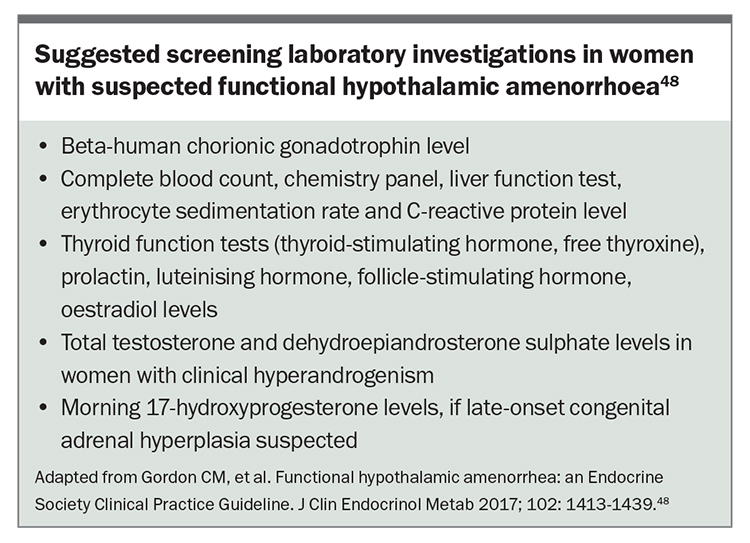
A recommended laboratory workup is outlined in the Box.48 In patients without signs of androgen excess, measuring follicle- stimulating hormone (FSH), LH, oestradiol, prolactin, thyroid-stimulating hormone and free thyroxine levels generally provides sufficient information to exclude most organic causes of secondary amenorrhoea, including hyperprolactinaemia, thyroid dysfunction and ovarian insufficiency.48 Anti-Müllerian hormone may help distinguish polycystic ovary syndrome from FHA.
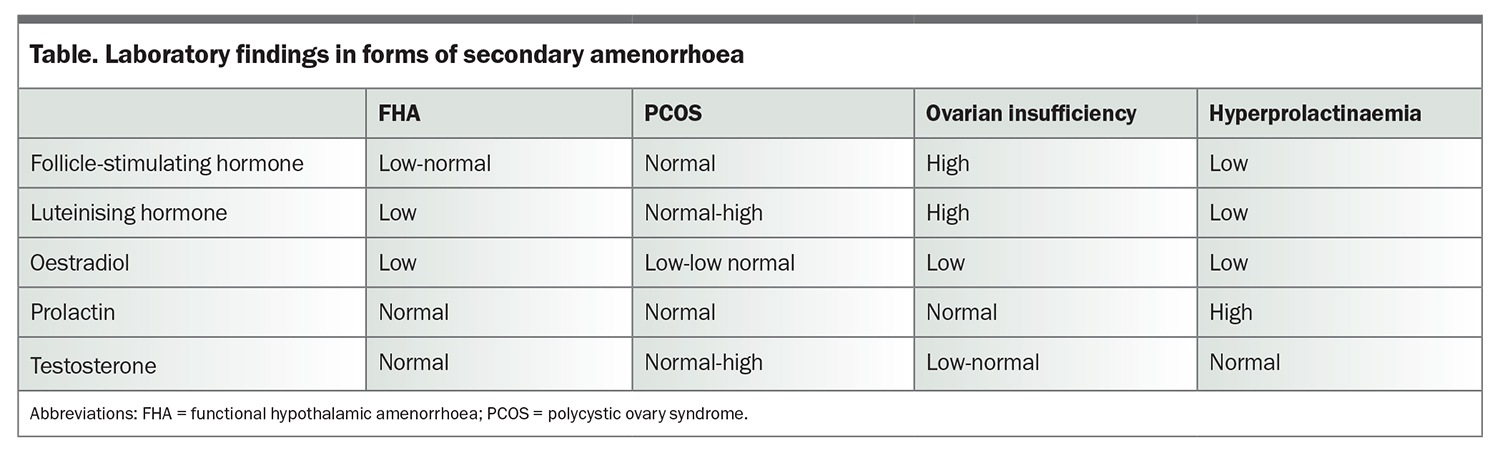
The pattern of hormone results can help differentiate between the different causes of secondary amenorrhoea. Women with FHA characteristically have low oestradiol levels with very low LH levels. FSH is less affected by the slowed GnRH pulse frequency and is usually normal.49 In contrast, women with polycystic ovary syndrome typically have a higher LH than FSH level. If both FSH and LH levels are very low, genetic causes that affect GnRH neuronal development or a structural lesion of the hypothalamus or pituitary should be considered. Common hormonal patterns seen in secondary amenorrhoea are summarised in the Table.
Imaging of the brain and pituitary is not recommended if there is a clear explanation for amenorrhoea such as disordered eating, excessive exercise or rapid weight loss.48 Conversely, MRI with pituitary views and contrast is recommended if the history suggests a possible structural lesion of the hypothalamus or pituitary, such as with headaches, vomiting, new-onset thirst or polyuria. MRI should also be considered if laboratory investigations indicate other pituitary hormone abnormalities.48
For women with primary amenorrhoea, outflow tract abnormalities of the reproductive organs should be initially excluded by imaging with a pelvic ultrasound. A pelvic ultrasound may also be useful if there is diagnostic uncertainty between FHA and other causes of amenorrhoea such as polycystic ovary syndrome. Women with FHA typically have a thin endometrial lining due to long-term low oestrogen exposure, with one study reporting a mean endometrial thickness of 1.5 mm or less.1,50
In adolescent girls or women with a history of six or more months of amenorrhoea, baseline bone mineral density (BMD) measurement by a dual-energy x-ray absorptiometry is recommended to establish the risk and magnitude of bone mass compromise and guide and ongoing management.51 Dual-energy x-ray absorptiometry may be warranted earlier in patients with evidence of severe nutritional deficiency, significant energy deficit or skeletal fragility.48
Management of FHA
The aim of treatment of FHA is to achieve a return to spontaneous menses by correcting the energy balance. Management requires a multidisciplinary approach, with accurate identification and treatment of the underlying cause(s).1,3 Behavioural change is usually necessary to address the aetiology.
Initial management should focus on lifestyle modification. Dietary intervention should aim to educate women about energy requirements balanced against energy expenditure. There is no specific amount of weight gain recommended, as there is likely to be inter-individual variation. In one study of adolescent girls with anorexia nervosa, a weight increase of 2.05 kg above the weight at which they became amenorrhoeic was associated with a return of menses.52 A weight of 90% of the ideal body weight was the average threshold for menstrual resumption.52
Cessation of exercise is unrealistic for professional athletes and challenging for women who exercise recreationally. Although there are no clear recommendations for reducing exercise in these women, some suggest introducing a rest day or reducing the intensity or volume of training.53
Psychological support should be considered to address any underlying stress and contributory behaviours. Cognitive behavioural therapy is effective in both restoring ovarian activity and improving neuroendocrine and metabolic function in adolescent girls and women with FHA.54,55
Hormone replacement therapy can be considered in adolescent girls and women with FHA who have not resumed menstruation after six to 12 months of nutritional, psychological and/or exercise modification.1-3,48 This is usually considered for those with a low BMD or evidence of skeletal fragility. Generally, short-term use of transdermal oestrogen therapy in combination with a cyclic oral progestogen is the recommended form of hormone replacement in adolescent girls and women with FHA. It has also been shown to improve bone density.48,56,57
The oral contraceptive pill (OCP) is not recommended for oestrogen replacement and may mask the return of spontaneous menses.48 The OCP has no significant benefit for bone health, possibly due to the down-regulatory effect of oral oestrogen on insulin-like growth factor-1, a mediator of bone growth and mineralisation.58-60 Furthermore, ethinyloestradiol (the most common oestrogen used in the OCP) is highly potent and suppresses GnRH and LH pulsatility through supraphysiological oestrogenic activity. In oligoamenorrhoeic athletes, 12 months of transdermal oestrogen has been shown to be superior to the OCP in improving BMD.59 Bisphosphonates, denosumab, testosterone and leptin are not currently recommended for improving BMD in adolescent girls and women with FHA.48
Women with FHA can experience escape ovulation; therefore, contraception is necessary for those who do not desire pregnancy.51 Transdermal oestrogen with a progestogen does not provide contraception. For women with FHA who wish to conceive, fertility treatment should not be initiated until underlying energy deficits are addressed and a body mass index of at least 18.5 kg/m2 is achieved to minimise adverse obstetric and neonatal outcomes.1,48
Conclusion
FHA is a common cause of secondary amenorrhoea, usually resulting from relative energy deficiency due to reduced nutritional intake, increased exercise or energy expenditure, or major psychological stress.
The most important pathway to diagnosis is to take a thorough history of potential risk factors for FHA, followed by targeted investigations to exclude other causes of amenorrhoea, such as pregnancy, polycystic ovary syndrome, hyperprolactinaemia, pituitary or other sellar tumours and premature ovarian insufficiency. Management is directed towards restoring energy balance and addressing psychological factors contributing to energy deficiency and stress, ideally with multidisciplinary input from other healthcare professionals, including psychologists and dietitians. Oestrogen and progestogen replacement should not be initiated immediately but may be appropriate for women who are delayed in achieving their nutritional goals. Ultimately, 70 to 80% of women with FHA will recover and achieve spontaneous menses. ET
COMPETING INTERESTS: None.
References
1. Roberts RE, Farahani L, Webber L, Jayasena C. Current understanding of hypothalamic amenorrhoea. Ther Adv Endocrinol Metab 2020; 11: 2042018820945854.
2. Klein DA, Poth MA. Amenorrhea: an approach to diagnosis and management. Am Fam Physician 2013; 87: 781-788.
3. Saadedine M, Kapoor E, Shufelt C. Functional hypothalamic amenorrhea: recognition and management of a challenging diagnosis. Mayo Clin Proc 2023; 98: 1376-1385.
4. Abreu APK, U.B. Gonadotrophin hormones. In: Melmed S, editor. The Pituitary: Elsevier; 2022. p. 209-255.
5. Bonazza F, Politi G, Leone D, Vegni E, Borghi L. Psychological factors in functional hypothalamic amenorrhea: a systematic review and meta-analysis. Front Endocrinol (Lausanne) 2023; 14: 981491.
6. Morrison AE, Fleming S, Levy MJ. A review of the pathophysiology of functional hypothalamic amenorrhoea in women subject to psychological stress, disordered eating, excessive exercise or a combination of these factors. Clin Endocrinol (Oxf) 2021; 95: 229-238.
7. Logue D, Madigan SM, Delahunt E, Heinen M, Mc Donnell SJ, Corish CA. Low energy availability in athletes: a review of prevalence, dietary patterns, physiological health, and sports performance. Sports Med 2018; 48: 73-96.
8. Iwasa T, Minato S, Imaizumi J, et al. Effects of low energy availability on female reproductive function. Reprod Med Biol 2022; 21: e12414.
9. Dipla K, Kraemer RR, Constantini NW, Hackney AC. Relative energy deficiency in sports (RED-S): elucidation of endocrine changes affecting the health of males and females. Hormones (Athens) 2021; 20: 35-47.
10. Witkos J, Wrobel P. Menstrual disorders in amateur dancers. BMC Womens Health 2019; 19: 87.
11. Mountjoy M, Sundgot-Borgen J, Burke L, et al. The IOC consensus statement: beyond the Female Athlete Triad--Relative Energy Deficiency in Sport (RED-S). Br J Sports Med 2014; 48: 491-497.
12. Slater J, McLay-Cooke R, Brown R, Black K. Female recreational exercisers at risk for low energy availability. Int J Sport Nutr Exerc Metab 2016; 26: 421-417.
13. Baranauskas MN, Freemas JA, Carter SJ, Blodgett JM, Pedlar CR, Bruinvels G. Amenorrhea and oligomenorrhea risk related to exercise training volume and intensity: findings from 3705 participants recruited via the STRAVA exercise application. J Sci Med Sport 2023; 26: 405-409.
14. Grinspoon S, Miller K, Coyle C, et al. Severity of osteopenia in estrogen-deficient women with anorexia nervosa and hypothalamic amenorrhea. J Clin Endocrinol Metab 1999; 84: 2049-2055.
15. Loucks AB, Thuma JR. Luteinizing hormone pulsatility is disrupted at a threshold of energy availability in regularly menstruating women. J Clin Endocrinol Metab 2003; 88: 297-311.
16. Melin A, Tornberg AB, Skouby S, et al. Low-energy density and high fiber intake are dietary concerns in female endurance athletes. Scand J Med Sci Sports 2016; 26: 1060-1071.
17. Reed JL, Bowell JL, Hill BR, Williams BA, De Souza MJ, Williams NI. Exercising women with menstrual disturbances consume low energy dense foods and beverages. Appl Physiol Nutr Metab 2011; 36: 382-394.
18. Podfigurna A, Maciejewska-Jeske M, Meczekalski B, Genazzani AD. Kisspeptin and LH pulsatility in patients with functional hypothalamic amenorrhea. Endocrine 2020; 70: 635-643.
19. Meczekalski B, Niwczyk O, Bala G, Szeliga A. Stress, kisspeptin, and functional hypothalamic amenorrhea. Curr Opin Pharmacol 2022; 67: 102288.
20. Caronia LM, Martin C, Welt CK, et al. A genetic basis for functional hypothalamic amenorrhea. N Engl J Med 2011; 364: 215-25.
21. Delaney A, Burkholder AB, Lavender CA, et al. Increased burden of rare sequence variants in GnRH-associated genes in women with hypothalamic amenorrhea. J Clin Endocrinol Metab 2021; 106: e1441-e52.
22. Chan JL, Mantzoros CS. Role of leptin in energy-deprivation states: normal human physiology and clinical implications for hypothalamic amenorrhoea and anorexia nervosa. Lancet 2005; 366: 74-85.
23. Miller KK, Parulekar MS, Schoenfeld E, et al. Decreased leptin levels in normal weight women with hypothalamic amenorrhea: the effects of body composition and nutritional intake. J Clin Endocrinol Metab 1998; 83: 2309-2312.
24. Welt CK, Chan JL, Bullen J, et al. Recombinant human leptin in women with hypothalamic amenorrhea. N Engl J Med 2004; 351: 987-997.
25. Amorim T, Khiyami A, Latif T, Fazeli PK. Neuroendocrine adaptations to starvation. Psychoneuroendocrinology 2023; 157: 106365.
26. Berga SL, Mortola JF, Girton L, et al. Neuroendocrine aberrations in women with functional hypothalamic amenorrhea. J Clin Endocrinol Metab 1989; 68: 301-308.
27. Berga SL, Daniels TL, Giles DE. Women with functional hypothalamic amenorrhea but not other forms of anovulation display amplified cortisol concentrations. Fertil Steril 1997; 67: 1024-1030.
28. Rickenlund A, Thoren M, Carlstrom K, von Schoultz B, Hirschberg AL. Diurnal profiles of testosterone and pituitary hormones suggest different mechanisms for menstrual disturbances in endurance athletes. J Clin Endocrinol Metab 2004; 89: 702-707.
29. Ackerman KE, Patel KT, Guereca G, Pierce L, Herzog DB, Misra M. Cortisol secretory parameters in young exercisers in relation to LH secretion and bone parameters. Clin Endocrinol (Oxf) 2013; 78: 114-119.
30. Misra M, Miller KK, Bjornson J, et al. Alterations in growth hormone secretory dynamics in adolescent girls with anorexia nervosa and effects on bone metabolism. J Clin Endocrinol Metab 2003; 88: 5615-5623.
31. Miyai K, Yamamoto T, Azukizawa M, Ishibashi K, Kumahara Y. Serum thyroid hormones and thyrotropin in anorexia nervosa. J Clin Endocrinol Metab 1975; 40: 334-338.
32. Misra M, Miller KK, Almazan C, et al. Alterations in cortisol secretory dynamics in adolescent girls with anorexia nervosa and effects on bone metabolism. J Clin Endocrinol Metab 2004; 89: 4972-4980.
33. Shufelt CL, Torbati T, Dutra E. Hypothalamic amenorrhea and the long-term health consequences. Semin Reprod Med 2017; 35: 256-262.
34. Vaananen HK, Harkonen PL. Estrogen and bone metabolism. Maturitas 1996; 23 Suppl: S65-S69.
35. Schorr M, Thomas JJ, Eddy KT, et al. Bone density, body composition, and psychopathology of anorexia nervosa spectrum disorders in DSM-IV vs DSM-5. Int J Eat Disord 2017; 50: 343-351.
36. Rencken ML, Chesnut CH 3rd, Drinkwater BL. Bone density at multiple skeletal sites in amenorrheic athletes. JAMA 1996; 276: 238-240.
37. Ackerman KE, Nazem T, Chapko D, et al. Bone microarchitecture is impaired in adolescent amenorrheic athletes compared with eumenorrheic athletes and nonathletic controls. J Clin Endocrinol Metab 2011; 96: 3123-3133.
38. Lawson EA, Donoho D, Miller KK, et al. Hypercortisolemia is associated with severity of bone loss and depression in hypothalamic amenorrhea and anorexia nervosa. J Clin Endocrinol Metab 2009; 94: 4710-4716.
39. Honigberg MC, Zekavat SM, Aragam K, et al. Association of premature natural and surgical menopause with incident cardiovascular disease. JAMA 2019; 322: 2411-2421.
40. Zhu D, Chung HF, Dobson AJ, et al. Age at natural menopause and risk of incident cardiovascular disease: a pooled analysis of individual patient data. Lancet Public Health 2019; 4: e553-e64.
41. Meczekalski B, Katulski K, Czyzyk A, Podfigurna-Stopa A, Maciejewska-Jeske M. Functional hypothalamic amenorrhea and its influence on women’s health. J Endocrinol Invest 2014; 37: 1049-56.
42. Bairey Merz CN, Johnson BD, Sharaf BL, et al. Hypoestrogenemia of hypothalamic origin and coronary artery disease in premenopausal women: a report from the NHLBI-sponsored WISE study. J Am Coll Cardiol 2003; 41: 413-419.
43. Hara Y, Waters EM, McEwen BS, Morrison JH. Estrogen effects on cognitive and synaptic health over the lifecourse. Physiol Rev 2015; 95: 785-807.
44. Marcus MD, Loucks TL, Berga SL. Psychological correlates of functional hypothalamic amenorrhea. Fertil Steril 2001; 76: 310-316.
45. Pedreira CC, Maya J, Misra M. Functional hypothalamic amenorrhea: impact on bone and neuropsychiatric outcomes. Front Endocrinol (Lausanne). 2022; 13: 953180.
46. O’Donnell E, Goodman JM, Harvey PJ. Clinical review: cardiovascular consequences of ovarian disruption: a focus on functional hypothalamic amenorrhea in physically active women. J Clin Endocrinol Metab 2011; 96: 3638-3648.
47. Ng E, Sztal-Mazer S, Davis SR. Functional hypothalamic amenorrhoea: a diagnosis of exclusion. Med J Aust 2022; 216: 73-76.
48. Gordon CM, Ackerman KE, Berga SL, et al. Functional hypothalamic amenorrhea: an Endocrine Society Clinical Practice Guideline. J Clin Endocrinol Metab 2017; 102: 1413-1439.
49. Tsutsumi R, Webster NJ. GnRH pulsatility, the pituitary response and reproductive dysfunction. Endocr J 2009; 56: 729-737.
50. Morcos RN, Leonard MD, Smith M, Bourguet C, Makii M, Khawli O. Vaginosonographic measurement of endometrial thickness in the evaluation of amenorrhea. Fertil Steril 1991; 55: 543-546.
51. Sophie Gibson ME, Fleming N, Zuijdwijk C, Dumont T. Where have the periods gone? The evaluation and management of functional hypothalamic amenorrhea. J Clin Res Pediatr Endocrinol 2020; 12(Suppl 1): 18-27.
52. Golden NH, Jacobson MS, Schebendach J, Solanto MV, Hertz SM, Shenker IR. Resumption of menses in anorexia nervosa. Arch Pediatr Adolesc Med 1997; 151: 16-21.
53. Ryterska K, Kordek A, Zaleska P. Has menstruation disappeared? Functional hypothalamic amenorrhea-what is this story about? Nutrients 2021; 13: 2827.
54. Michopoulos V, Mancini F, Loucks TL, Berga SL. Neuroendocrine recovery initiated by cognitive behavioral therapy in women with functional hypothalamic amenorrhea: a randomized, controlled trial. Fertil Steril 2013; 99: 2084-2091 e1.
55. Berga SL, Marcus MD, Loucks TL, Hlastala S, Ringham R, Krohn MA. Recovery of ovarian activity in women with functional hypothalamic amenorrhea who were treated with cognitive behavior therapy. Fertil Steril 2003; 80: 976-981.
56. Misra M, Katzman D, Miller KK, et al. Physiologic estrogen replacement increases bone density in adolescent girls with anorexia nervosa. J Bone Miner Res 2011; 26: 2430-2438.
57. Behary P, Comninos AN. Bone perspectives in functional hypothalamic amenorrhoea: an update and future avenues. Front Endocrinol (Lausanne) 2022; 13: 923791.
58. Aalberg K, Stavem K, Norheim F, Russell MB, Chaibi A. Effect of oral and transdermal oestrogen therapy on bone mineral density in functional hypothalamic amenorrhoea: a systematic review and meta-analysis. BMJ Open Sport Exerc Med 2021; 7: e001112.
59. Ackerman KE, Singhal V, Baskaran C, et al. Oestrogen replacement improves bone mineral density in oligo-amenorrhoeic athletes: a randomised clinical trial. Br J Sports Med 2019; 53: 229-236.
60. Singhal V, Ackerman KE, Bose A, Flores LPT, Lee H, Misra M. Impact of route of estrogen administration on bone turnover markers in oligoamenorrheic athletes and its mediators. J Clin Endocrinol Metab 2019; 104: 1449-1458.
Single article purchases are temporarily unavailable due to site maintenance.
If you would like to purchase an article during this time, please email us at [email protected] with the article details and we'll assist you directly. We'll also let you know when online purchasing is available again.
Thank you for your patience and understanding.