
Differentiating Hashimoto’s thyroiditis and Graves’ disease

Dr Mok is an Nuclear Medicine and Provisional Theranostics Fellow in the Department of Nuclear Medicine at Royal North Shore Hospital, Sydney.
Dr Hoang is a Endocrinologist and Nuclear Medicine Physician at Royal North Shore Hospital and The University of Sydney, Sydney; Head of Department of Endocrinology at Hornsby Ku-ring-gai Hospital; and Clinical Senior Lecturer at Sydney Medical School, The University of Sydney, Sydney, NSW.
DEAR EDITOR: We thank Dr Rachel Zuzek and Dr Albert Hsieh for their article on ‘Differentiating Hashimoto’s thyroiditis and Graves’ disease: a practical guide’, which was published in the May 2025 issue of Endocrinology Today and discusses the common causes of thyroid dysfunction, namely Hashimoto’s thyroiditis (HT) and Graves’ disease (GD).1 The article helpfully outlines key differences in the investigation of these two conditions.
The article describes differences in imaging findings, with HT having near-zero uptake on the Pertechnetate thyroid scan and GD usually having high uptake. However, it is important to note that these differences are not as distinct as suggested.
Unlike subacute thyroiditis, which typically causes no or minimal uptake on the thyroid scan, HT can mimic a variety of thyroid disorders.2 Although HT can cause minimal uptake, it can also commonly present with nodular or diffuse Graves-like uptake. The Graves-like appearance on the thyroid scan may be due to the presence of stimulating thyroid-stimulating hormone (TSH) receptor antibodies, and has been reported in 25% of patients with HT.1-4 The nodular appearance may reflect the presence of mixed damaged and normal thyroid tissue. In patients presenting with hyperthyroidism, differentiating between HT (hashitoxicosis) and GD based solely on imaging findings can be difficult, and care should be taken in interpreting the scan, particularly in patients with mild hyperthyroidism and without typical features of GD.
We present a case of a 38-year-old woman with mild hyperthyroidism, most likely due to hashitoxicosis. Her initial free thyroxine (T4) level was 27.1 pmol/L (9.0–25.0 pmol/L), free triiodothyronine (T3) level 7.0 pmol/L (3.5–6.0 pmol/L) and TSH level 0.01 mIU/L (0.4–4.0 mIU/L). Her antithyroid peroxidase antibody level was 2665 U/mL (<13.8 U/mL), antithyroglobulin antibody level 664U/mL (<4.5 U/mL) and thyroid-stimulating immunoglobulin level 1.09 U/L (<0.55 U/L). Thyroid scan showed a Graves-like appearance with diffuse increased uptake (Figure). Her thyroid function improved gradually without treatment. Repeat measurement of the free T4 level two months later was 14.8 pmol/L, free T3 level 4.4 pmol/L and TSH level 0.03 mU/L.
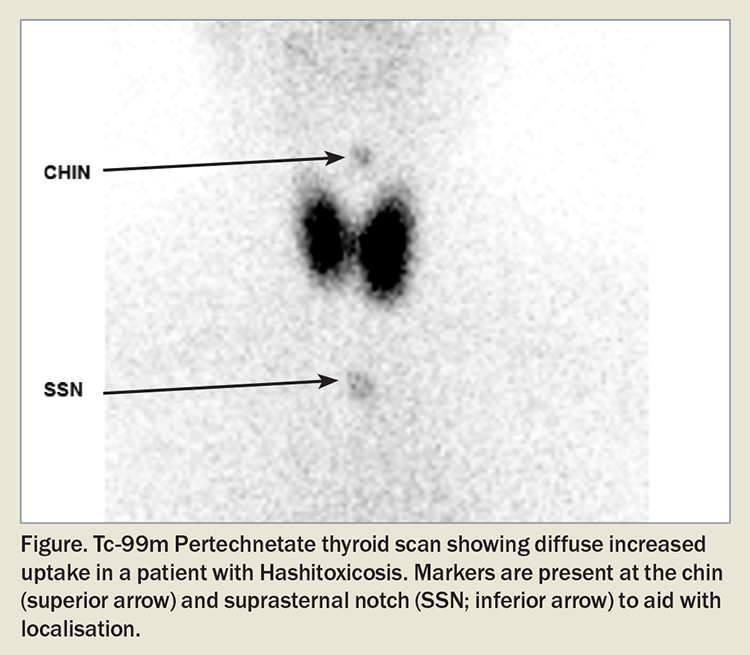
In the evaluation of patients with hyperthyroidism associated with thyroid autoimmunity, if there is no or minimal uptake on thyroid scan, HT can be confidently diagnosed. However, if there is diffuse increased uptake, while GD is the most likely cause of this pattern, HT cannot be excluded. If the patient lacks other clinical findings of GD, HT should be considered as a key differential diagnosis. In these cases, seeking an opinion from an endocrinologist should be considered as, with time, the hyperthyroid phase of HT convalesces naturally into a euthyroid or hypothyroid phase. In this select group, watchful waiting is the most appropriate clinical approach, as opposed to commencement of antithyroid medication.
References
1. Rachel Z, Hsieh A. Differentiating Hashimoto’s thyroiditis and Graves’ disease: a practical guide. Endocrinology Today 2025; 14(2): 8-13.
2. Ramtoola S, Maisey MN, Clarke SE, Fogelman I. The thyroid scan in Hashimoto’s thyroiditis: the great mimic. Nucl Med Commun 1988; 9: 639-645.
3. Diana T, Krause J, Olivo P, et al. Prevalence and clinical relevance of thyroid stimulating hormone receptor-blocking antibodies in autoimmune thyroid disease. Clin Exp Immunol 2017; 189: 304-309.
4. Giannone M, Dalla Costa M, Sabbadin C, et al. TSH-receptor autoantibodies in patients with chronic thyroiditis and hypothyroidism. Clin Chem Lab Med 2022; 60: 1020-1030.
Send your letters to:
Medicine Today, PO Box 1473, Neutral Bay, NSW 2089,
or [email protected]